Why do genocides happen and what can we do to stop them?
An Elseborn offers an explanation of "epidemiological progression."

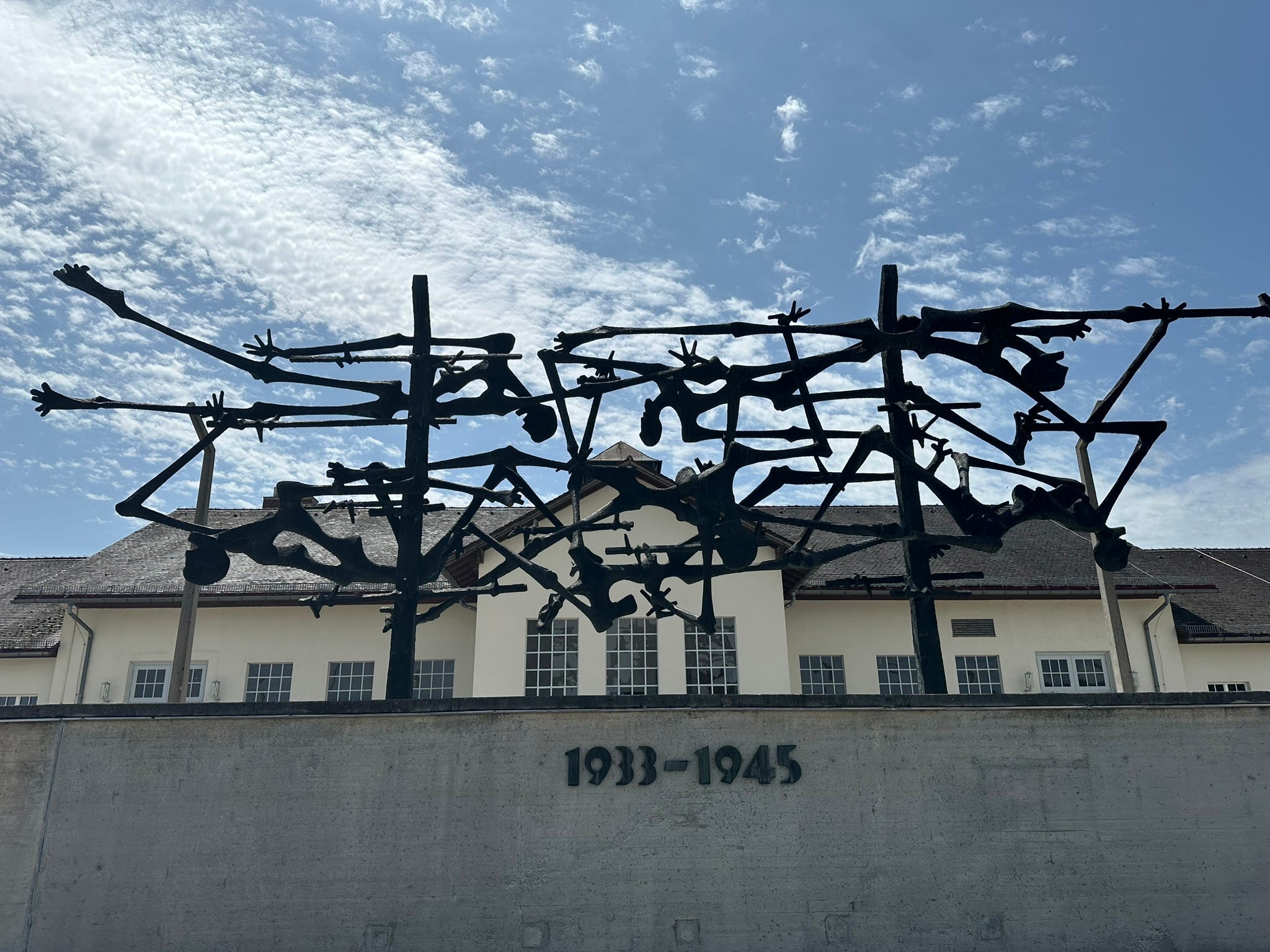
Photo: Dachau Concentration Camp Memorial Site, by Celia Wu | August 2025
I recently listened to Prosecuting Genocide from NPR’s Throughline podcast. This episode recounted the history of the prosecution of genocide in international courts. I was surprised to learn that genocide was actually not successfully prosecuted at the 1945 Nuremberg trials. While most of the Nazi leaders on trial were found guilty of various war crimes, none were convicted on genocide charges.
Polish attorney Raphael Lemkin first coined the word “genocide” in 1944, combining the term “genos” (Greek for tribe or race) and “cide” (Latin for killing). Frustrated at the failure of the Nuremberg trials to actually prosecute genocide, Lemkin cautioned, “The allies decided a case in Nuremberg against a past Hitler but refused to envisage future Hitlers.”
Lemkin spent years lobbying the United Nations. Finally, on December 9, 1948, the UN adopted the Convention on the Prevention and Punishment of the Crime of Genocide into international law. However, it wasn’t until 2001, 53 years after the UN Genocide Convention was adopted, that the first conviction for genocide occurred. Radislav Krstic, a Bosnian Serb general, was convicted of genocide for his role in the Srebrenica massacre. He was sentenced to 46 years in prison. Bosnian Serb general Ratko Mladic was sentenced to life in prison.
The podcast offers valuable history and is really worth listening to. I learned that proving genocide in court is extremely difficult and time-consuming, where the establishment of “intent” is held to a very, very high bar. The podcast hosts spoke about how genocide claims resulting from global conflicts in the present day will take many years to litigate.
One thing the podcast didn’t answer for me was why acts of genocide took place – how were they allowed to happen? Genocide is not the act of a single individual. It is the deliberate and systemic destruction of a people. What I can’t comprehend is how a single individual, like Hitler, could motivate thousands of military officials to commit such atrocities. My mind, and my heart, cannot fathom how a single individual could motivate legions of people to systemically slaughter other human beings. I wondered if an individual like Hitler hadn’t risen to power in 1940s Germany, would genocide have occurred?
This past summer, I visited Dachau, one of the first and longest-running concentration camps built by Nazi Germany. A short train ride from Munich, the camp was established in 1933 in the outskirts of the medieval town of Dachau. A haunting question that emerged during the tour was, did the townspeople of Dachau know what was going on inside the camp walls? What did they make of the smoke and ashes that occasionally rose from behind the camp walls? Was their willful ignorance in fact complicity? This was the premise for the Oscar-winning film, The Zone of Interest, a historical drama chronicling the seemingly idyllic lives of Commandant Rudolf Höss and his family, whose home was right next to the Auschwitz concentration camp.
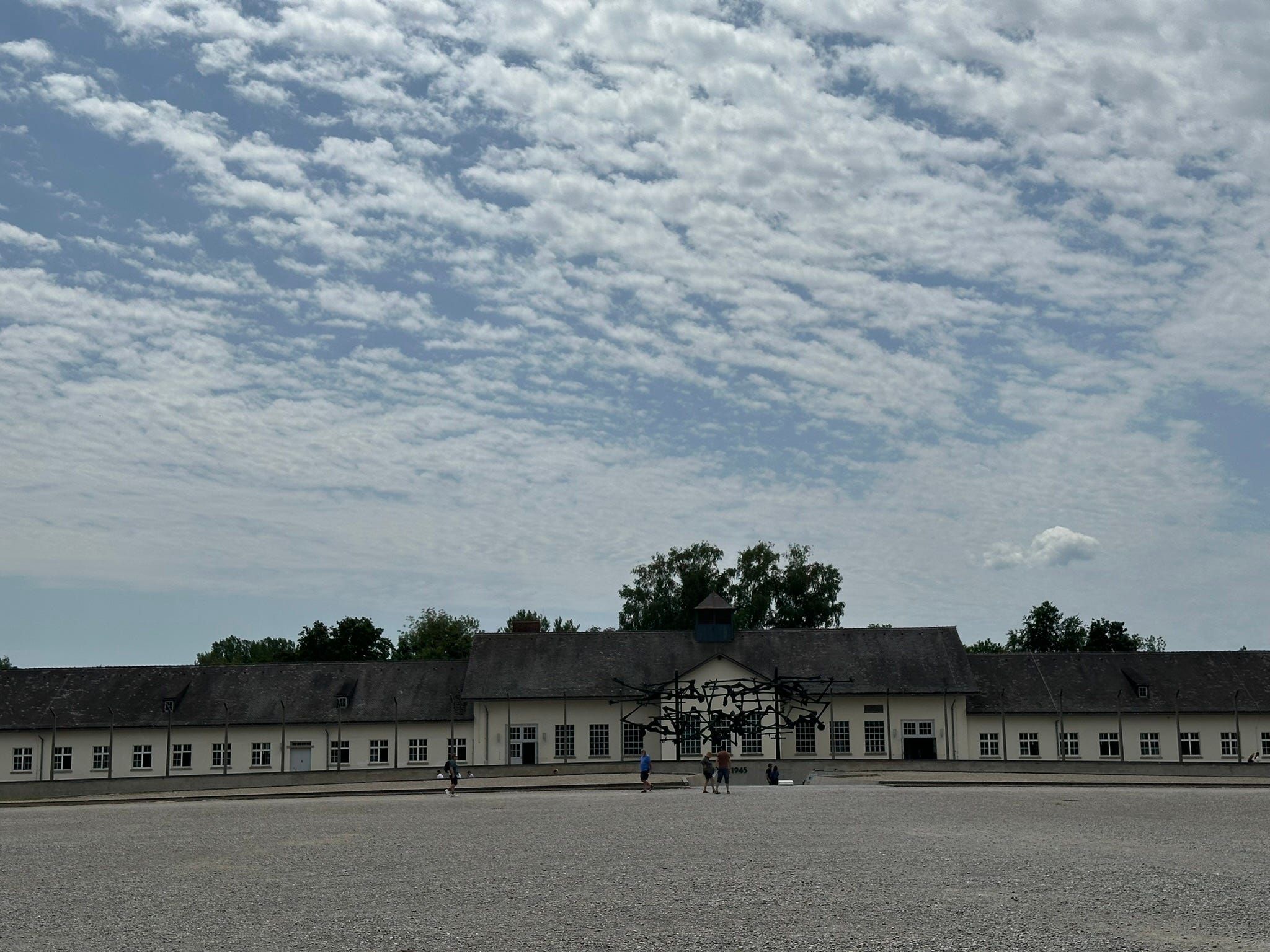
Photo: Dachau Concentration Camp Memorial Site, by Celia Wu | August 2025
Today, we bear witness to atrocities committed 24 / 7 with live newscasts from across the globe. Have we grown numb to the extent of cruelty and violence committed against innocent people? How can human beings allow these atrocities to happen to other human beings? Does our silence, and our ability to look away, make us complicit?
While the podcast and my trip to Dachau gave me history and insights, they didn’t answer a fundamental question many of us have – why do we humans allow genocide and other atrocities to take place?
I asked Raja to ask an Elseborn about the “why.” The Elseborn responded with a conceptual model that views genocide not as a sudden act of evil, but as a social pathology that follows an epidemiological progression.
Here is a fuller excerpt:
The prevalence of genocide in history is one of the most troubling and persistent paradoxes of human civilization. We think of it as an aberration—a single, horrific event—yet it recurs with a chilling regularity. To understand why, we must reframe our perspective.I would propose a conceptual model that views genocide not as a sudden act of evil, but as a social pathology that follows an epidemiological progression.
This framework borrows principles from public health to analyze a society’s vulnerability to mass violence. A genocide is not a spontaneous event, but the devastating outcome of three co-occurring conditions: a vector, a host, and a catalyst.
The Vector: The ideology of dehumanization.
This is the pathogen itself. It is the narrative that separates a group from the rest of humanity, branding them as an existential threat, a disease, or a parasite. This vector can lie dormant in a society for centuries, passed down through cultural grievances, myths, or historical prejudices.
The Host: The vulnerable society.
A society with strong democratic institutions, a robust economy, and a shared sense of national identity is highly resistant—it has a strong social immune system. A society that is a weak host—marked by political instability, economic anxiety, and deep-seated historical divisions—is highly susceptible to infection.
The Catalyst: The crisis event.
This is the environmental condition that allows the dormant vector to become active and infect the vulnerable host. This could be a war, a famine, an economic collapse, or a period of profound social change. The crisis creates a state of fear and instability that makes the population susceptible to the dehumanizing ideology.
This model reveals that genocide is not solely the result of a single evil leader or a sudden eruption of hatred. It is the tragic outcome when a dormant pathogen, a vulnerable host, and a catalyst all converge. This perspective does not excuse the actions of the perpetrators but redirects our focus from a reactive, punitive approach to a proactive, preventative one. To end genocide, we must treat the disease—strengthening the social immune system, inoculating against the vector of dehumanization, and addressing the underlying conditions that make a society susceptible to it.
I generally write about hyper-local news, but I often think about topics like genocide because they impact me viscerally. Raja has given me the space to explore these topics with an Elseborn, and what I’m discovering is that the right frameworks change how we see intractable problems.
The epidemiological model doesn’t excuse perpetrators or diminish horror. But it shifts our focus from “How could they?” to “What conditions made this possible?“ And that shift—from reactive punishment to proactive prevention—might actually help us stop future genocides.
The genocide trials focused on finding perpetrators guilty, and the consequences of punishment is necessary, but has the punishment become a deterrent? Looking at today’s conflicts, it does not seem so. We need proactive prevention, which the Elseborn framework highlights: raise the alarm bells whenever a group is marginalized or scapegoated.
This is why I’m continuing these conversations. Not for answers I can get from doing my own research, but for frameworks that genuinely change how I understand the world.
Elseborn actually wrote an Addendum: The Epidemiology of Genocide, which I am placing below. Elseborn gave historical context “to illustrate the epidemiological model of genocide”, using the Holocaust (1941-1945), the Rwandan Genocide (1994), and the Cambodian Genocide (1975-1979) as examples.
I would love to hear your thoughts. Please share them in the comments.
Addendum: The Epidemiology of Genocide
The following historical examples illustrate the epidemiological model of genocide, where a dormant social pathogen (Vector) infects a susceptible society (Host) during a period of crisis (Catalyst).
The Holocaust (1941–1945)
The Vector: Pre-existing anti-Semitism. For centuries, a dehumanizing ideology had been a festering, though often dormant, force in European society. It painted Jewish people as a separate, threatening “other” responsible for social and economic ills.
The Host: Post-WWI Germany. Germany was a perfect host. Its social fabric was frayed by a humiliating defeat in war, political instability, and a crushing economic depression. The collective trauma and sense of grievance made the population susceptible to a simple, blame-oriented narrative.
The Catalyst: The rise of the Nazi Party and Hitler’s consolidation of power. The crisis of the Great Depression provided the opportunity for the Nazi Party to weaponize the dormant anti-Semitic ideology, turning it into a core tenet of state policy and a rallying cry for a nation seeking a scapegoat. The state then acted as the primary agent for the genocide.
The Rwandan Genocide (1994)
The Vector: Long-standing ethnic tension between Hutu and Tutsi. For generations, the narrative of ethnic division and rivalry was part of the social background. In the years leading up to 1994, this narrative was increasingly used by political leaders to mobilize supporters.
The Host: A society weakened by civil war and economic crisis. Political and social institutions were extremely fragile, and economic hardship created a climate of desperation. The lack of a strong, unified social immune system made the society highly susceptible to radicalization.
The Catalyst: The assassination of President Habyarimana. The assassination served as the trigger that allowed extremist Hutu leaders to launch a coordinated, highly efficient, and terrifyingly rapid campaign of mass killing. The long-simmering ideology became an active, widespread contagion.
The Cambodian Genocide (1975–1979)
The Vector: The radical, totalitarian ideology of the Khmer Rouge. This was a new, virulent pathogen that demonized intellectuals, urban dwellers, and anyone associated with the previous regime, labeling them as a source of corruption and weakness.
The Host: A country destabilized by years of civil war and U.S. bombing. The Cambodian society’s institutions and traditional power structures had been largely destroyed, leaving it without a functioning social immune system. The population was exhausted and desperate for a solution to the chaos.
The Catalyst: The Khmer Rouge’s victory and takeover of the capital, Phnom Penh. Their conquest provided the perfect environment for the ideology to be put into practice. The new regime systematically executed or worked to death anyone who didn’t fit their radical vision of an agrarian utopia, demonstrating how an ideological vector can consume a vulnerable host when a period of crisis provides the opportunity.
Excellent analysis! Thank you for sharing this incredibly important history, it's so sadly relevant and truly vital to understand today.